PC Builds, Sourced Entirely From Amazon
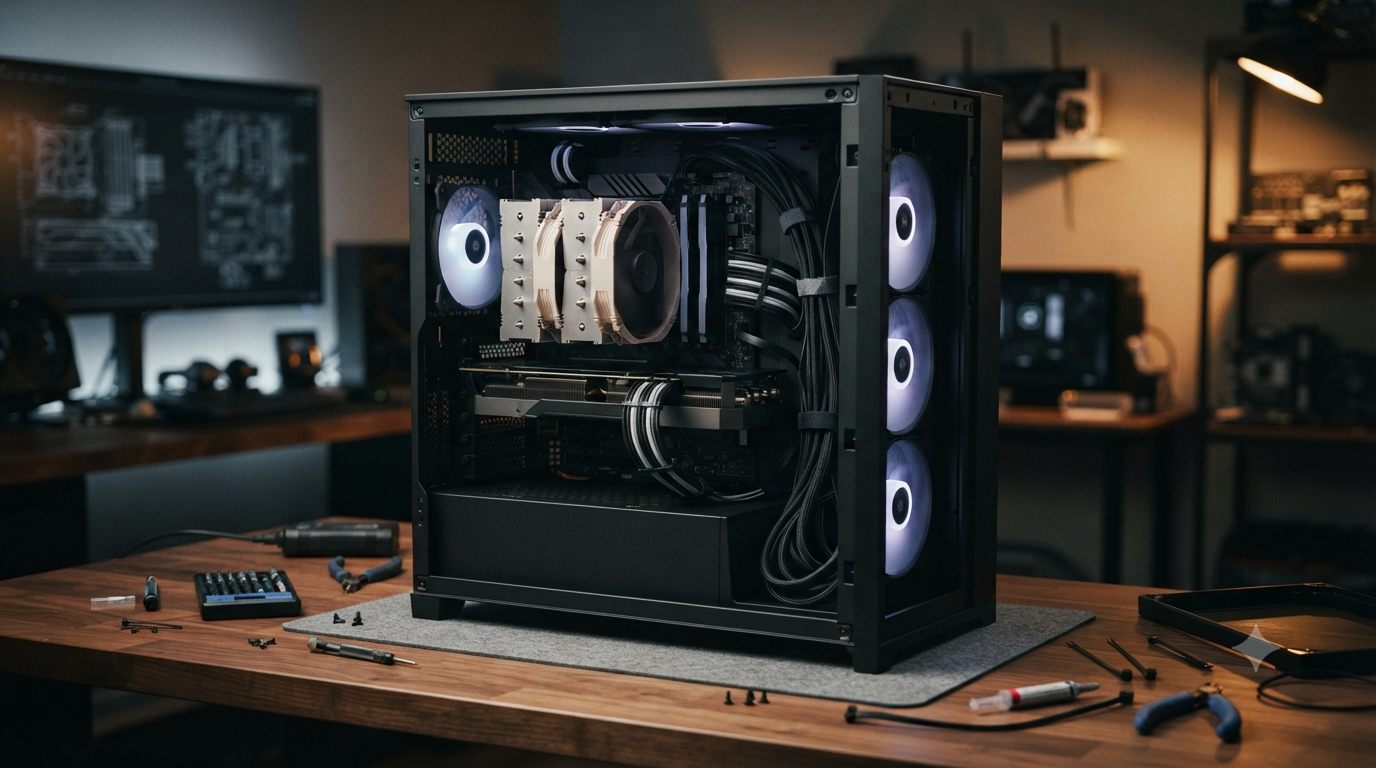
Part-picker tools assume you can buy from anywhere — but if you only want to click "buy" on Amazon, half their picks are unavailable, backordered, or third-party marked up. Rig Builder Lab does the opposite: every component CLASS below is chosen so an Amazon search actually returns real, current stock, and every build guide is a shopping list by class (CPU class, GPU class, PSU class), not one brittle exact SKU. No prices, no star ratings, no invented ASINs — every pick names an honest tradeoff.
Most build guides either quote exact part numbers that vanish from shelves within months, or lean on marketing specs (GPD-style wattage ratings, "10-stage" style stage inflation, bare MT/s numbers) instead of what the spec actually means for your build. We start from the part numbers themselves — what a PSU's wattage rating really means under real system draw, what RAM speed actually buys you in games, whether Gen4 vs Gen5 NVMe is even something you can feel — then apply that to Amazon-sourceable component classes.
Key Facts
- A PSU's wattage rating is a ceiling, not your system's real draw — a typical 6-8 core + one mid-range GPU gaming PC pulls roughly 250-450W at the wall, well under a 650-750W unit's rating; the headroom exists for millisecond-long GPU power spikes, not everyday load.
- 80 Plus tiers (Bronze/Gold/Platinum/Titanium) certify power-supply efficiency at specific load percentages — they say nothing about build quality, protection circuitry, or reliability, which is why two Gold-rated units from different brands can have very different real-world track records.
- RAM speed has real but fast-diminishing returns: going from slow to mid-speed DDR5 (roughly 4800 to 6000 MT/s) can meaningfully help some CPU-bound titles; going from mid to top-tier speed (6000 to 8000+) usually nets single-digit percentage gains — often inside normal benchmark variance.
- Gen4 vs Gen5 NVMe is not a felt difference in games or everyday use. Game load times and app launches are dominated by random 4K reads and engine/OS overhead, not the sequential-throughput numbers that make Gen5 look dramatically faster on a spec sheet.
- A CPU cooler should be matched to the CPU's actual TDP/PPT rating for its configured power mode, not just its model name — the same CPU model can ship configured at very different power limits.
- Case airflow class is a real, measurable engineering tradeoff: independent thermal benchmarking consistently shows mesh-front cases running several degrees cooler than glass-front variants of the same case at equal fan speed and noise — the glass-front tradeoff is aesthetics and dust filtering, not a myth, but it has a real thermal cost.
- GPU power connectors are not interchangeable by appearance: the newer 12VHPWR/12V-2x6 connector has documented melting incidents tied to partial seating and tight cable bends, versus the long safety record of legacy 8-pin PCIe connectors — always use the exact adapter or cable the GPU manufacturer specifies.
- A single "bottleneck percentage" from a calculator can't know your resolution or settings — the same CPU/GPU pair can be GPU-bound at 4K and CPU-bound at 1080p in the same game. Match GPU tier to target resolution class instead of trusting one output number.
Build guides — by resolution/use class
Budget 1080p Build
A component-class list for smooth 1080p gaming at high settings — every slot named by class, not one exact SKU that goes out of stock next month.
9 component classes →
Mid 1440p Build
A component-class list built around a real 1440p-capable GPU tier with enough CPU and RAM headroom that nothing else in the build bottlenecks it.
9 component classes →
Quiet Workstation Build
A component-class list tuned for sustained CPU-heavy work (compiling, rendering, multitasking) with low fan noise as the design constraint, not an afterthought.
9 component classes →
Start here — the four slots that decide the build
If you buy nothing else in the right order, buy these four. Socket mismatch between CPU and motherboard is the single most common reason a first build does not post, and an underspecced PSU is the second. Each links to a live Amazon search for the component class rather than one exact model, so the link still works after a SKU sells out.
6-core current-gen budget class (e.g. Ryzen 5 / Core i5 non-K tier)
Why this class: 6 cores is the current 1080p sweet spot; don't overspend on an 8-core here — the GPU is the bottleneck at this tier.
Search this class on AmazonNot deciding today? Add it to your cart over there — Amazon keeps it saved (and flags any price change) until you're ready.
8GB mid-range class (e.g. RTX 4060 / RX 7600 tier)
Why this class: 8GB VRAM is the current 1080p-high floor; going below it means turning textures down in newer titles.
Search this class on AmazonNot deciding today? Add it to your cart over there — Amazon keeps it saved (and flags any price change) until you're ready.
Budget B-series board (B650/B760 tier), current CPU socket
Why this class: Confirm the exact socket (AM5, LGA1700, etc.) matches your chosen CPU class before buying — this is the #1 compatibility mistake.
Search this class on AmazonNot deciding today? Add it to your cart over there — Amazon keeps it saved (and flags any price change) until you're ready.
550-650W, 80 Plus Bronze, ATX, fully or semi-modular
Why this class: Bronze is fine at this tier; the certification tells you efficiency, not build quality — buy from a name brand with a real multi-year warranty, not the cheapest badge-only unit.
Search this class on AmazonNot deciding today? Add it to your cart over there — Amazon keeps it saved (and flags any price change) until you're ready.
Decode the part numbers first
How we work
We're a research-based site: we compare manufacturer specifications (PSU wattage/80 Plus certification, RAM JEDEC/XMP speeds, NVMe PCIe generation, cooler TDP ratings) and independent thermal/acoustic benchmarking methodology (GamersNexus-class testing conventions) rather than claiming to have built every listed combination ourselves. We never invent an exact ASIN, never publish prices, and every component class names an honest tradeoff. Read our full methodology →